EP 092 The FBI Burglary That Revealed COINTELPRO | Conspiracy History
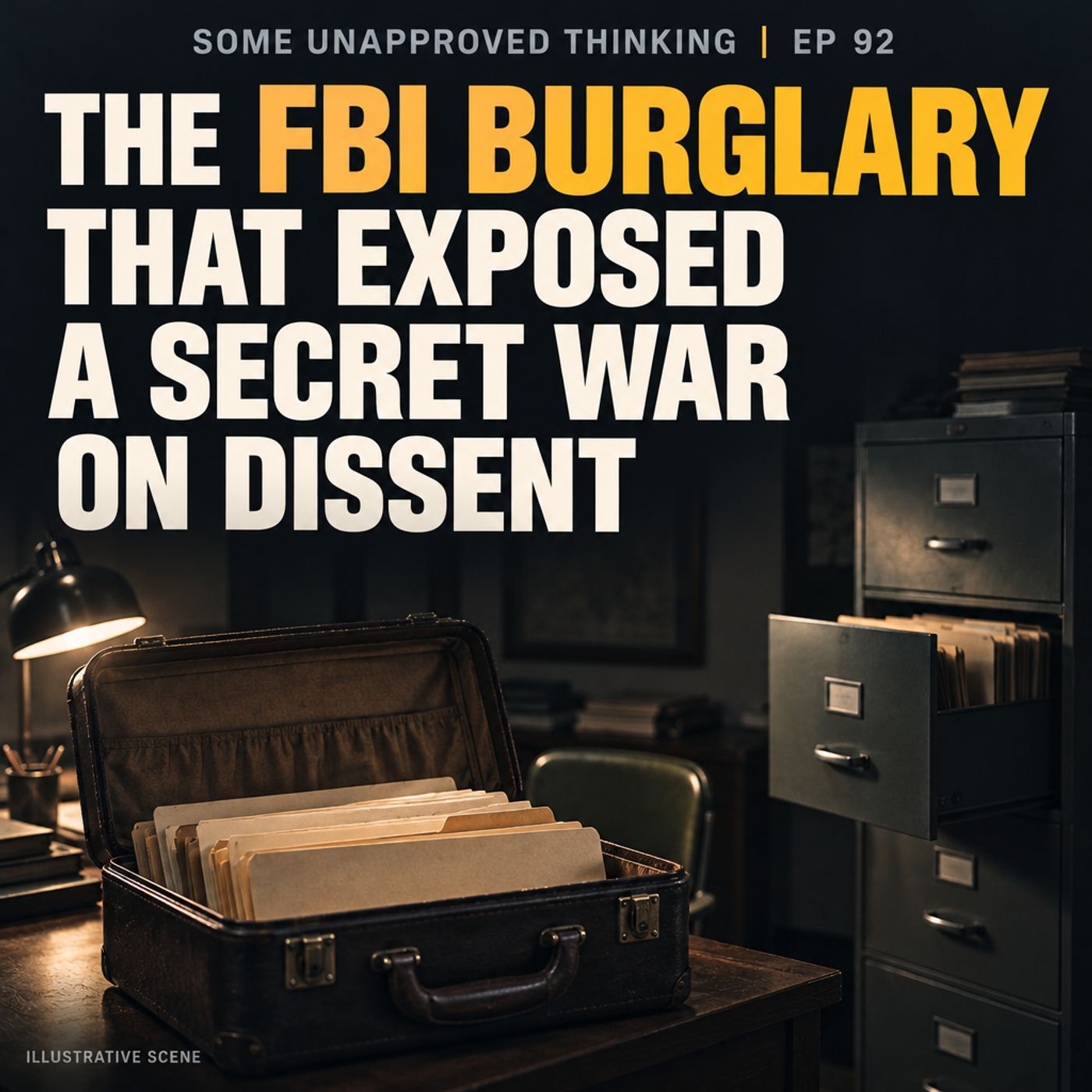
The 1971 FBI Office Burglary That Exposed COINTELPRO (Media, PA) | Conspiracy History COINTELPRO and FBI surveillance came into public view after eight anti-war activists broke into a small FBI office in Media, Pennsylvania, in 1971. Hear how they copied and circulated the files, what the documents revealed about government monitoring, and how journalists and later Church Committee findings shaped the story. This episode weighs the ethical questions around publishing stolen records and asks what oversight can—and cannot—prevent. https://SomeUnapprovedThinking.com/s1e92 (get your resource here) Sponsor - YourSuccessDNA.com


The 1971 FBI Office Burglary That Exposed COINTELPRO (Media, PA) | Conspiracy History
COINTELPRO and FBI surveillance came into public view after eight anti-war activists broke into a small FBI office in Media, Pennsylvania, in 1971. Hear how they copied and circulated the files, what the documents revealed about government monitoring, and how journalists and later Church Committee findings shaped the story. This episode weighs the ethical questions around publishing stolen records and asks what oversight can—and cannot—prevent.
https://SomeUnapprovedThinking.com/s1e92 (get your resource here)
Sponsor - YourSuccessDNA.com
Open the Free Media Burglary Case File
In March 1971, eight anti-war activists calling themselves the Citizens’ Commission to Investigate the FBI burglarized a small FBI office in Media, Pennsylvania during the Ali–Frazier fight, seeking proof the Bureau was surveilling and intimidating Vietnam War opponents. They removed roughly 1,000 documents, reviewed them at a farmhouse, and mailed copies to journalists and officials; The Washington Post published Betty Metzger’s story despite government requests not to. The files revealed monitoring of anti-war activity and Black communities, including guidance to “enhance paranoia,” and introduced the label COINTELPRO, which later reporting and FOIA litigation helped expand into evidence of a broader domestic covert program. The script also discusses ethical objections to publishing stolen materials, the Church Committee’s findings on disruptive tactics and harms, COINTELPRO’s claimed termination in 1971 with possible continuation, and subsequent oversight reforms.
00:00 The Media Break In
01:51 Meet the Citizen Sleuths
03:08 Planning the Heist
04:48 Inside the FBI Office
06:47 What the Files Revealed
08:56 Publishing the Leak
10:56 COINTELPRO Exposed
12:42 Church Committee Findings
17:10 Was It Really Over
19:16 Aftermath and Reforms
21:00 How to Verify Sources
22:00 Why Oversight Matters
23:29 Final Thoughts
COINTELPRO, 1971 FBI burglary, FBI surveillance, Media Pennsylvania, FBI break-in, Church Committee, FBI, Citizens' Commission to Investigate the FBI, COINTELPRO findings, Betty Medsger, Bill Davidon, J Edgar Hoover, conspiracy history, declassified documents, alternative history, conpiracy, conspiracies, conspiracy theories, conspiracy theory, government conspiracy, hidden conspiracy, hidden history, historical conspiracies, history conspiracies, history conspiracy, history insights, investigative history, media conspiracy, patterns of history, revisionist history, untold history
https://SomeUnapprovedThinking.com
Hosted by Simplecast, an AdsWizz company. See pcm.adswizz.com for information about our collection and use of personal data for advertising.
[00:00:00] Tracy Brinkmann: If you wanna know what the FBI is doing, you could write a letter, you could call your congressman, [00:00:05] or apparently, you could wait until the biggest boxing match in the country, break [00:00:10] into a small FBI office, and carry the answers out in a suitcase. Now, mind [00:00:15] you, that last option is a felony, and it's not the audience participation portion of this [00:00:20] particular episode of the podcast.
[00:00:21] But back on March 8th, 1971, a [00:00:25] team of eight anti-war activists did exactly that in a town called Media, [00:00:30] Pennsylvania. Now, they weren't going in there to steal cash. They wanted evidence that the FBI [00:00:35] was secretly watching and intimidating people who opposed the Vietnam War. And guess [00:00:40] what? Yeah, they found it.
[00:00:41] And one of the most revealing ideas in those files wasn't [00:00:45] about catching somebody. It was about making people feel watched. [00:00:50] Reporter Betty Metzger later described a document instructing agents to, quote, [00:00:55] "enhance paranoia," unquote, to make people think there was, quote, "an FBI [00:01:00] agent behind every mailbox," unquote.
[00:01:02] Let that sit for a second, right? [00:01:05] Imagine discovering that the very fear you've been told was unreasonable was actually [00:01:10] something an agency was trying to encourage. The FBI launched a huge [00:01:15] investigation to find the burglars. It didn't catch them, but the files that those burglars carried out helped [00:01:20] expose something much larger than one little office in Media, Pennsylvania.
[00:01:23] The mystery is how a [00:01:25] suitcase of stolen paperwork becomes a trail into the government's campaign against its own [00:01:30] citizens. And that, my friends, calls for some unapproved thinking.
[00:01:33] Bumper Lady: Beneath the headlines, [00:01:35] behind the timelines, there is a story no one wants you to find. Welcome to Some [00:01:40] Unapproved Thinking, where forgotten truths, buried patterns, and [00:01:45] invisible systems rise to the surface.
[00:01:47] You weren't crazy. You were just early. [00:01:50] Let's begin
[00:01:51] Tracy Brinkmann: Bill Davidon taught physics in Haverford [00:01:55] College. John Raines taught religion at Temple University. His wife, Bonnie, was an [00:02:00] anti-war activist who later worked in child advocacy. Keith Forsyth had driven a [00:02:05] cab and learned lock picking while being involved in protests against the [00:02:10] draft.
[00:02:10] Now, these were some of the people behind the operation. I, I tell you this because you have to [00:02:15] notice they're not a foreign intelligence team. They're not employees walking out with documents that they [00:02:20] were authorized to see. They were people on the outside trying to find out what was happening on the [00:02:25] inside.
[00:02:25] In later interviews, they described a growing conviction that ordinary protests [00:02:30] just wasn't gonna handle anymore. They believed that the FBI was infiltrating and [00:02:35] intimidating the peace movement. That belief explains their decision. Now, mind you, it doesn't by [00:02:40] itself establish that every suspicion they had was true, and that's why the [00:02:45] documents matter.
[00:02:45] Davidon proposed breaking into a local FBI office to obtain that [00:02:50] evidence. The group called themselves Citizens' Commission to Investigate the FBI. Yeah , [00:02:55] that's an impressive title. Now, mind you, the credentials, they are self-issued. Their investigation [00:03:00] would have involved a crowbar. But that self-ascribed name told you what they thought [00:03:05] was missing, somebody willing to investigate the investigators.
[00:03:08] They watched that [00:03:10] FBI office in Media, Pennsylvania, which was just outside Philadelphia, and they were studying who came in [00:03:15] and who came out, who came and who went. Then Bonnie Raines decided to go inside. According to [00:03:20] her later account, she posed as a college student asking about opportunities for women [00:03:25] in the FBI, at the FBI.
[00:03:26] She tucked her long hair up into a winter hat, she put on some [00:03:30] glasses, and she kept her gloves on. She was there to look at the office's security [00:03:35] without leaving fingerprints behind. Now, I want you to take a minute and consider the risk in that. If the [00:03:40] burglary happened, the FBI agents were surely to remember the unusual visitor.
[00:03:44] This wasn't an [00:03:45] anonymous question that was being shouted from the back of a crowd at some public government meeting. She [00:03:50] was putting her face in front of people who could later come looking for her. John and Bonnie [00:03:55] They had children. So whatever you think of their decision, the possible consequences weren't [00:04:00] limited to the adults that were making that decision.
[00:04:02] The group chose March 8th. That was the [00:04:05] night that Muhammad Ali fought Joe Frazier in New York. They hoped that the enormous attention [00:04:10] around the fight would help distract people from the small FBI office in Pennsylvania. [00:04:15] Now, one detail needs cleaning up before the cliché cinematic movie version takes over [00:04:20] here.
[00:04:20] This wasn't a fight that everyone in America could watch on their television [00:04:25] in their living room. In the United States at this particular point in time, it was gonna be shown through closed circuit [00:04:30] screenings with updates reaching people through other media coverage, radio, right? Occasional news [00:04:35] broadcast.
[00:04:35] Back then, it wasn't like you could just flip on ESPN or Amazon Prime and glue your [00:04:40] face to the TV like you can today. The distraction was real. The familiar picture of every [00:04:45] household watching the same live broadcast, not so much. All right? It was a different era. But the burglars' [00:04:50] plan was about to develop a much more immediate problem.
[00:04:53] You see, Forsythe [00:04:55] was supposed to get them in. He had practice. He had a plan. Then, like any [00:05:00] cliché adventure or spy movie He found a high security lock [00:05:05] he had not expected. Now, there's something painfully ordinary about that part of this extraordinary [00:05:10] story. There was months of preparation, then a single [00:05:15] door was declining to participate, putting a big red X across their access.
[00:05:19] According to [00:05:20] Forsythe's account to NPR, he went back to confer with the others. They decided to keep [00:05:25] trying. He returned and worked on another door using his trusty crowbar. He later [00:05:30] recalled what should have taken minutes probably took at least an hour. Now, let's keep the source of [00:05:35] that scene clear.
[00:05:36] That is his recollection, and it was given decades afterwards, right? We [00:05:40] know how those stories can kinda get inflated. We don't have a recording of the hallway where the crowbar was put [00:05:45] into play here. Okay? So what we do know is that the office was entered, and we [00:05:50] do have an account from the other side of that door where the crowbar was employed.
[00:05:54] Former FBI [00:05:55] agent Pat Kelly told NBC News that he and a colleague discovered the office [00:06:00] ransacked. Drawers had been searched. Files were scattered. Agent Kelly remained angry about [00:06:05] this burglary long afterwards. To him, these people were not patriots. They were [00:06:10] criminals. Hard stop. And we're gonna be going back to that objection in a little bit because it [00:06:15] deserves better than just being edited out of this story altogether.
[00:06:17] You see, the burglary team took [00:06:20] files away in suitcases. Later reporting describes as many as 1,000 documents. [00:06:25] Now, we don't need to turn an, an approximate count into a sacred number here to understand what [00:06:30] actually happened. The files were taken to a farmhouse outside of town, and they were examined. Now came [00:06:35] the part that no amount of watching the building could guarantee.
[00:06:38] They had risked going to [00:06:40] prison to open those cabinets. Would the contents of what it is they took support what [00:06:45] it was they believed? Hmm? Yeah. Good question. The files contained evidence of [00:06:50] FBI attention to anti-war activity as well as Black communities, not simply a list of people charged [00:06:55] with crimes.
[00:06:55] NBC's reporting describes instructions to monitor people visiting Black [00:07:00] bookstores and to recruit informants. NPR's account describes files on people [00:07:05] whose activity included writing letters to the editor opposing the war. Now, [00:07:10] I say this 'cause I want you to think about how ordinary that is. You disagree with the government.
[00:07:14] You put your [00:07:15] name on a letter. That act in and of itself should not automatically become a reason to treat you as a [00:07:20] threat. Should it? No. But the mailbox language reveals another layer. [00:07:25] Metzger described a document encouraging agents to enhance paranoia, to make [00:07:30] people feel like there was an FBI agent behind every mailbox I want [00:07:35] you to notice that goal there.
[00:07:36] It's not only learning what a group is doing, it's literally [00:07:40] affecting what the group feels safe doing. Now, if, if people think they're being [00:07:45] watched, they may s- I don't know, stop attending meetings. They may distrust the person sitting [00:07:50] beside them if they attend the meeting. They may decide a letter, a conversation, or an [00:07:55] association isn't worth the trouble Now, that, mind you, that's my explanation of how [00:08:00] intimidation can work.
[00:08:01] It's not a, a claim that we can measure every person's response to a single [00:08:05] memo or even 1,000 of them. But the distinction between gathering information and shaping [00:08:10] behavior is right at the heart of this story. You don't need to put an agent behind every [00:08:15] mailbox. You just need enough people wondering whether there is one.
[00:08:19] Y- you feel [00:08:20] me? Is there a, a, an FBI agent behind that mailbox? Now, mind you, this is the '70s. Mailboxes were on [00:08:25] almost every corner out there. It's a remarkably economical way to make a free society [00:08:30] do some of the restricting for you. Yeah, they become self-containing. And for the people [00:08:35] already experiencing the harassment, the uncertainty, well, it could be a bit [00:08:40] exhausting.
[00:08:40] I mean, the questions that would be rushing through your head at that point is, "Who can I trust? Is that person [00:08:45] really interested in the cause that we're fighting for? Will this cost me my job, my family, [00:08:50] my life?" Those are consequences that you should take, that they should take very seriously, not [00:08:55] symptoms to laugh at.
[00:08:56] The stolen files gave journalists something they could [00:09:00] examine beyond just the activists' suspicions, but first, somebody had to publish them. On the [00:09:05] morning of March 23rd, 1971, Betty Metzger found an envelope at The [00:09:10] Washington Post. In her later first-person account, she recalled the return address, Liberty Publications, [00:09:15] Media, Pennsylvania, Media being the city in Pennsylvania.
[00:09:17] Inside were the stolen FBI documents [00:09:20] and a letter explaining where they had come from. The burglars had sent copies to journalists [00:09:25] as well as public officials. They hadn't yet won the public argument. No, no. They had created a [00:09:30] decision for the people receiving the packages, and that decision would be, "Should I return the [00:09:35] files?
[00:09:35] Should I investigate them? Should I publish them?" At a later public discussion reported [00:09:40] by station KQED, Metzger described how other newspaper recipients [00:09:45] decided to turn the documents over to the FBI. The Post, however, made a different choice. The [00:09:50] administration asked the Post not to publish. Publisher Katharine Graham [00:09:55] allowed the story to run.
[00:09:56] So on March 24th, the Post published Metzger's reporting. [00:10:00] That's the second act of judgment in this story, and that act is separate from the burglary. [00:10:05] The activists decided to obtain and distribute the documents. The newspaper decided [00:10:10] that the information about the FBI's conduct belonged in the public eye Right?
[00:10:14] Act two. [00:10:15] And the public could now examine the conduct that the agency hadn't volunteered to explain [00:10:20] itself. So if you're thinking stolen materials creates a real ethical problem, then yes, that- I'm [00:10:25] gonna give that a nod. Okay, let's, let's, let's keep that there. But it can also expose [00:10:30] private people. It can endanger legitimate work.
[00:10:32] A publisher still has to evaluate authenticity, [00:10:35] relevance, and all of that possible harm. Calling something a leak doesn't perform those [00:10:40] checks for you, but neither does calling something stolen answer the question of whether it reveals [00:10:45] wrongdoing that's actually happening. How did you get that, and what does it show?
[00:10:49] [00:10:50] Those are two completely different questions, and both of those questions do deserve an answer. One does [00:10:55] not make the other one disappear. So among the materials that emerged from Media, Pennsylvania, [00:11:00] was an unfamiliar label at the time, COINTELPRO. That was short for [00:11:05] Counterintelligence Program. Now, that's not a friendly little office abbreviation like, you know, one on a folder containing the [00:11:10] mileage claims for the cars that were being used.
[00:11:12] But at a first glance, the label itself [00:11:15] didn't explain the whole system that was behind that label. And this is where the [00:11:20] fast version of the story often cheats. Eight people break in, they find everything. The [00:11:25] nation learns everything. Cue the closing music. No, no, no. No. The Media, [00:11:30] Pennsylvania documents supplied a lead.
[00:11:32] More reporting and more legal pressure were [00:11:35] needed to follow that lead. NBC reporter Carl Stern pursued the records [00:11:40] behind that label through an array of Freedom of Information Acts, including [00:11:45] A lawsuit. The Senate's later report explicitly traces that connection. Documents from [00:11:50] Media Pennsylvania carried the COINTELPRO caption, and Stern sought other records about the [00:11:55] programs.
[00:11:55] Now, that's a much more useful story than a, a suitcase containing every answer [00:12:00] that was carried out, legally or no. Sometimes the most valuable thing inside of a [00:12:05] document is a name of the next thing that you need to investigate, and finding that [00:12:10] next thing, well, let's be honest, it takes work. It takes requests.
[00:12:13] It takes denials. It takes [00:12:15] follow-ups. Heck, sometimes it even takes court proceedings, the part of the investigative history that [00:12:20] rarely gets into the movie trailer because, "Then somebody reviewed another filing," just [00:12:25] doesn't sell that much popcorn, does it? No, but let's be honest. You know and I know it still matters.
[00:12:29] [00:12:30] Without the follow-through, an unexplained label can stay just that, an unexplained label. [00:12:35] With it, however, a story widened from one office to an entire system [00:12:40] of domestic covert action. In 1975 and 1976, the [00:12:45] Senate's Church committee investigated intelligence abuses. Its work reached far [00:12:50] beyond that Pennsylvania media burglary and far beyond the FBI itself.
[00:12:53] Other disclosures and [00:12:55] other investigations helped bring it about. Now, this wasn't a Congressional committee summoned [00:13:00] into existence by that one break-in of those anti-war activists. No, no. But when its [00:13:05] staff examined COINTELPRO, the findings, well, they were stark. The [00:13:10] report describes programs that began in 1956, I want you to hear that number, [00:13:15] 1956, that went beyond collecting intelligence.
[00:13:18] The FBI secretly tried to [00:13:20] disrupt and neutralize groups and individuals. The report documented tactics [00:13:25] including anonymous letters intended to damage marriages and false claims that people were [00:13:30] police informants. Whoa, wait a minute. Let that sit in. Let that sink in for a second. I want you to think [00:13:35] about that second tactic.
[00:13:36] If a group out there already figures they're being [00:13:40] infiltrated, falsely identifying someone as an informer doesn't just create some awkward [00:13:45] meeting setting. No, it can destroy trust around that person, and let's be honest, it could [00:13:50] put them at risk. The committee describes serious acts of physical, emotional, and economic [00:13:55] harm.
[00:13:55] Look, that's not me. That's not us putting some sinister interpretation into the [00:14:00] word intelligence. That's what a real investigation found the methods could do. [00:14:05] The programs targeted categories including the Communist Party, the Socialist Workers Party, [00:14:10] white hate groups, Black nationalist groups, and the New Left.
[00:14:14] Those [00:14:15] categories g- don't neatly describe everyone caught inside of them. The committee specifically [00:14:20] warned against accepting the FBI labels as precise descriptions. It noted [00:14:25] that the nonviolent Southern Christian Leadership Conference had been labeled a Black [00:14:30] nationalist hate group. If the label is broad enough, the label can do all the accusing for [00:14:35] us before anyone even looks at a specific person.
[00:14:37] Some targeted organizations and some targeted [00:14:40] individuals were involved in violence, yes, and that fact really does matter. But it [00:14:45] doesn't make every target violent, and it doesn't authorize every method that was used [00:14:50] against them. The report addressed that distinction very directly. Preventing [00:14:55] violence is in fact a legitimate purpose of law enforcement, but, and this is a big [00:15:00] but, attacking lawful speech, association, and membership is not made [00:15:05] acceptable by describing a whole operation as "prevention," he says with air quotes.[00:15:10]
[00:15:10] The government has to investigate actual threats without giving itself some sort of [00:15:15] standing permission slip to damage people whose politics it just happens to dislike or disagree [00:15:20] with. And that's a difficult responsibility. Don't get me wrong, I understand that, but it also [00:15:25] is the responsibility. The existence of a hard job doesn't turn the [00:15:30] Constitution into an optional attachment for some email.
[00:15:33] No, it doesn't. But, uh, let's [00:15:35] return to Pat Kelly. That's that agent whose office was burglarized, the guy that held onto that anchor for a long [00:15:40] time. He told NBC that people don't have the right to take it upon themselves to decide [00:15:45] what should be made public. Ooh, really? That's a real objection, and that's a real objection from a real [00:15:50] person.
[00:15:50] We shouldn't reduce it to somebody being annoyed that the wrong side won. A private group [00:15:55] entering an office and taking files can harm people, and it can harm legitimate investigations. [00:16:00] That's fact Being convinced that you are right does not make you incapable of doing [00:16:05] damage. Ugh, right? You feel me?
[00:16:07] Okay. You're, you're still listening, so I'm gonna say yes, you do. [00:16:10] The burglars believed that their action was justified by what the FBI was doing [00:16:15] and by the failure of other institutions to confront what the FBI was doing. Now, [00:16:20] you get to evaluate that judgment on your own, but the contents of the documents, well, they have to be [00:16:25] evaluated too, don't they?
[00:16:26] And this is about the time I can hear it in my magic headphones that there's somebody out there [00:16:30] with a much weaker objection. Let's call them my keyboard warrior. They're gonna say something like, "Buh, [00:16:35] they were burglars. None of the evidence should count. Fruit of a poisonous tree. Buh." Right? Okay.
[00:16:39] [00:16:40] Excellent. Apparently, the filing cabinet becomes innocent if someone opens it and they don't have [00:16:45] permission. No. No, no, no. The burglary can be illegal, and the documents that [00:16:50] reveal government misconduct, well, those are facts that are perfectly capable of sitting [00:16:55] inside the same room. But the reverse is also true as well.
[00:16:57] Exposing misconduct doesn't make [00:17:00] every decision by the people exposing it wise or harmless, or even a model that you should copy, [00:17:05] right? Remember, it's a felony, okay? You don't have to hand out halos before we read the files, right? Okay. [00:17:10] Now, there is another part of the story that sounds wonderfully tidy until you read the details.
[00:17:14] [00:17:15] The wonderfully tidy part, COINTELPRO ended. Well, let's get to the details. The committee traced [00:17:20] its formal termination to late April 1971, weeks after that [00:17:25] Media Pennsylvania break-in. Its report says the Bureau ended the programs for [00:17:30] security reasons. For security reasons, inside quotes. Not a phrase that tell us the institution had [00:17:35] suddenly discovered some moral quandary or some moral problem in the program itself.
[00:17:39] In this [00:17:40] context, the committee linked the ending to a threat of public exposure. Then comes the [00:17:45] sentence that should stop all the victory music that's out there. The termination instructions allowed [00:17:50] recommendations for counterintelligence action to be submitted in exceptional circumstances [00:17:55] under individual case headings.
[00:17:56] The committee reproduced the instruction. Quote, [00:18:00] "These recommendations will be considered on an individual basis." Let that sit for a [00:18:05] second. So basically, the named programs were over, but there was still a route for [00:18:10] proposing the same kind of action, but those aren't the same thing. More importantly, the committee [00:18:15] reported that at least three instances of COINTELPRO-type activity after [00:18:20] its formal termination.
[00:18:21] It also said it couldn't determine the full extent of any [00:18:25] continuation. That's the finding. Not nothing has changed. That's what was found out. Not that we can prove [00:18:30] every latter activity was secretly the same program. Sorry, I can't give you some smoking gun or smoking guy [00:18:35] in a room going, "Ha ha ha ha, that's what happened."
[00:18:37] The official ending didn't establish that the [00:18:40] conduct had completely stopped, and that's a big problem if you ask me. Apparently, the filing system was [00:18:45] capable of reforming faster than the behavior of the folks that were keeping files in that filing [00:18:50] system. And that raises a question worth considering.
[00:18:52] When an institution says a program has [00:18:55] ended, what changes besides the name under the paperwork that it travels in? I [00:19:00] think the answer there might be more substantial, but we should ask for the answer, not [00:19:05] congratulate the folder. I wanted us to ask for the answer to that question. When it [00:19:10] ends, what changes?
[00:19:11] Did it just shift? Did the name just change? Do we break it down into [00:19:15] smaller programs? What? While these disclosures unfolded, the FBI was still looking for the [00:19:20] people who had, uh, broke into their offices. Hundreds of agents were involved in the investigation. [00:19:25] The burglars were not caught. They returned to their lives, and they kept their secret for [00:19:30] decades.
[00:19:30] Bonnie Raines later described the life that included work, study, and even driving a, a [00:19:35] carpool. That, that's, really, if you think about it, that's a dramatic contrast. A federal investigation on [00:19:40] one side, carpool school pickup on the other Right? You feel me? It, that's almost black [00:19:45] and white at its finest right there.
[00:19:46] But don't mistake ordinary routines for an absence of [00:19:50] consequences. They had made a decision that could have separated them from their families for a very, very long [00:19:55] time, if not forever, and they lived for years without publicly explaining what it was that they [00:20:00] had done. Their public information came in 2014 alongside Metzger's [00:20:05] book called The Burglary.
[00:20:06] That later reporting gives us so much of the human [00:20:10] detail. The Senate record gives us a different kind of evidence about the government's conduct. I think [00:20:15] both are useful, but they're not really interchangeable here. The participants' recollections don't [00:20:20] establish every institutional finding, and the official report does not tell us about every private [00:20:25] conversation inside the group.
[00:20:26] What followed the exposure also wasn't a single [00:20:30] clean victory. It's not like you could wrap this up like at the end of a, a Brady Bunch episode. Journalists [00:20:35] continued working. Congress investigated. Oversight arrangements and rules [00:20:40] changed. The Senate established a permanent intelligence oversight committee in [00:20:45] 1976.
[00:20:45] Reforms did happen. Don't get me wrong. So did the difficulties of making them [00:20:50] stick. The honest ending has room for both. And I, I just, I always wanna be h- honest [00:20:55] with you here. I'm not gonna give you all sunshine and rainbows, but also not, I'm not gonna try and blow smoke up your [00:21:00] butt at the same time.
[00:21:00] If you wanna follow the paperwork rather than just hear the story, I put together a free [00:21:05] Media burglary case file. You can go to someunapprovedthinking.com/s, [00:21:10] the letter S, 1, the number 1, E as in Edward, 92. Right? [00:21:15] Someunapprovedthinking.com/s1e92. The link will also be down in the description, so you [00:21:20] can just click right through.
[00:21:20] Here's what you're gonna find in it. You're gonna find the timeline, the links to the reporting and to the [00:21:25] Senate filings, and a short checklist for separating what the burglary exposed from [00:21:30] what the later investigations established, including the difference between ending a [00:21:35] program and ending a practice.
[00:21:36] Go ahead, read it. Check me. Gut check me. Call me out if [00:21:40] I made an error somewhere in here. I'm happy to enter into some dialogue on this. And for a wider [00:21:45] history of the bureau's documented abuses, maybe you go back and check out episode 68, [00:21:50] FBI Conspiracies That Were Actually True. Episode 68 gives you another route [00:21:55] into the institution that they were trying to expose.
[00:21:57] You'll find that link down in the description as well. Okay? [00:22:00] So let's get back to that office in Media, Pennsylvania. Before the break-in, the files were [00:22:05] there. The instructions were there. The people affected were already living with the [00:22:10] consequences. What changed wasn't that someone invented a, a more disturbing explanation.
[00:22:14] Uh, [00:22:15] the records became available to people who could challenge the explanation they had been given Right? [00:22:20] So only because of the break-in. But it took more than eight people and a suitcase. Yeah, [00:22:25] that was just the start. It took a reporter opening an envelope. It took that reporter's publisher [00:22:30] deciding to print.
[00:22:30] It took other journalists following a, a label, pulling at yet [00:22:35] another thread from inside those papers, investigators reading what the agency had [00:22:40] written, and a public, you and I, able to ask questions that the [00:22:45] institution hadn't chosen for it to know. The, the FBI never caught the people who entered the [00:22:50] office, and the more important result, I don't think was their escape.
[00:22:53] It was that the contents of [00:22:55] the office didn't stay there. We shouldn't have to depend on eight people trying to do [00:23:00] some sort of Ocean's 11 type of activity to learn that an agency within the own [00:23:05] government that we vote into office is undermining the freedoms that it's actually supposed to be [00:23:10] protecting, and that's what oversight is meant to prevent.
[00:23:12] So when someone says there's nothing to [00:23:15] investigate here, I think the useful question for you to have isn't whether their voice sounds reassuring. [00:23:20] It's whether anyone outside the institution is actually allowed to check, [00:23:25] but that is going to require some unapproved thinking. Tracy out.
[00:23:29] Bumper Lady: [00:23:30] If this story didn't sit right with you, good.
[00:23:32] You're not here to be comforted. You're here [00:23:35] to see what others overlook. Thanks for exploring some unapproved thinking. Learn [00:23:40] more at someunapprovedthinking.com. New episodes drop weekly. [00:23:45] Subscribe, share, and keep questioning because the pattern's still playing out, [00:23:50] and next time, we're going deeper.